Two numbers appear on almost every window quotation: a U-value and an energy rating. They measure related things in different ways.
What a U-value measures
A U-value is the rate at which heat passes through a building element, in watts per square metre per degree of temperature difference (W/m²K). Lower is better. A single-glazed window is around 5 W/m²K; an early double glazed unit around 3; a modern A-rated window between 1.2 and 1.4; a good triple glazed window under 1.0.
Whole window, frame and centre pane
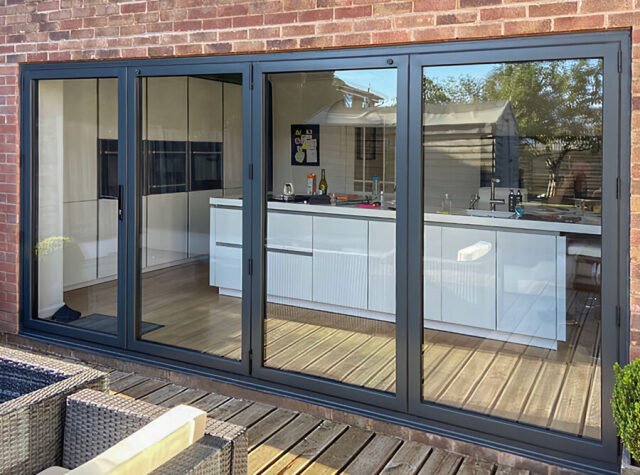
Manufacturers publish several U-values and it pays to know which is which. The centre-pane U-value describes the glass unit alone, measured at its middle. The frame U-value describes the profile. The whole-window U-value combines the two, weighted by area, and includes the edge of the glass where the spacer bar sits. Whole-window figures are the ones that matter for Building Regulations, and they are always higher than the centre-pane figure. When Smart Systems say the Visofold achieves 1.4 W/m²K "using a 1.0 centre pane", that is a whole-door figure achieved with a good glass unit.
Frames
Where chambers and thermal breaks come in
A PVCu profile such as the VEKA M70 is divided into chambers, five in the M70, each trapping still air. More chambers and deeper frames mean a lower frame U-value. Aluminium conducts heat, so an aluminium frame is split by a polyamide thermal break; the wider the break, the better. Smart widened the Visofold's break to 30 mm in its latest revision for exactly this reason.
Window Energy Ratings
The Window Energy Rating (WER) scheme, run in the UK by bodies including the British Fenestration Rating Council and the Thermal Rating Register, grades whole windows from A++ down to E, like an appliance label. Unlike a U-value, the rating also credits useful solar gain through the glass and penalises air leakage, so it is a measure of the window's overall energy balance rather than heat loss alone. The VEKA Imagine vertical slider is rated A; the M70 achieves A and can reach A++ with suitable glass and hardware.
What the Regulations require
Building Regulations in Wales set a maximum whole-window U-value for replacement windows and doors in existing homes and a tighter target for new builds. All the systems we fabricate meet the replacement requirement with standard glass and can meet new-build targets with the appropriate unit. Ask us to confirm the figure for the exact specification on your quotation.
The glass makes the difference
- Low-E coating: a microscopic metallic coating that reflects heat back into the room. Essential; all our units have it.
- Argon fill: a heavier gas than air between the panes, reducing convection.
- Warm-edge spacer: a plastic or composite spacer bar instead of aluminium, cutting heat loss and condensation at the edge of the glass.
- Triple glazing: a third pane and second cavity. The biggest step down in U-value, at extra cost and weight.
Comparing quotations
Make sure every quotation states the whole-window U-value or the WER for the same glass specification. A quotation quoting a centre-pane figure will look better than one quoting a whole-window figure for an identical window. If in doubt, ask for both.
Related questions
What is a U-value and what should I look for?
A U-value measures how quickly heat passes through a window or door: the lower the number, the better the insulation. It is expressed in W/m²K. Current Building Regulations in Wales set maximum U-values for replacement windows and doors, and the systems we fabricate all meet them. As a guide, the VEKA M70 achieves down to 1.2 W/m²K double glazed and 0.86 W/m²K triple glazed, and the Smart Visoglide Plus reaches 1.1 W/m²K with upgrade profiles. The glass unit makes the biggest difference, so tell us if heat loss is a priority.
Is triple glazing worth it?
Triple glazing lowers the U-value of the whole window and reduces noise, at extra cost and weight. It is worth considering for rooms that are hard to heat, north-facing elevations and houses near busy roads. For most South Wales homes a good A-rated double glazed unit is the sensible choice. The M70, Imagine patio door, Visofold and Visoglide systems all accept triple glazed units, so the option is open on any of our products.
What do PAS 24 and Secured by Design mean?
PAS 24 is the British security standard for doors and windows. A PAS 24 product has passed physical attack tests on the frame, locks and hinges. Secured by Design is the UK police initiative that specifies PAS 24 products together with other measures for new homes. All of the window and door systems we fabricate are PAS 24 tested, and the VEKA and Smart systems are capable of meeting Secured by Design when specified with the appropriate hardware and glass.
Products mentioned
Ask for the figure
Every quotation we issue can state the whole-window U-value for the specified glass. Just ask.